Reysys scans your container images, GitLab repositories and Kubernetes clusters, then scores every finding across CVE, CVSS, EPSS, SSVC and KEV — so your team works down one ranked list instead of thousands of alerts.
Runs as SaaS or self-hosted, in your infrastructure.
Reysys runs two ways, with the same scanning and scoring engine in both.
Connect your registry, GitLab and clusters. Nothing to operate.
Deploy the full platform into your own infrastructure. Images, findings and inventory never leave your perimeter, and you decide where it runs.
For teams under national data-residency requirements, self-hosted keeps every artifact and every finding inside infrastructure you control. A separate enrichment service downloads the public vulnerability databases — CVE, KEV and EPSS — so the only thing crossing your boundary is reference data coming in.
Most teams run one scanner for images, another for repositories and a third for clusters. Three tools, three backlogs, no shared sense of what matters. Reysys analyses all three against the same signals and produces a single ranked list, with the fix attached to each finding.
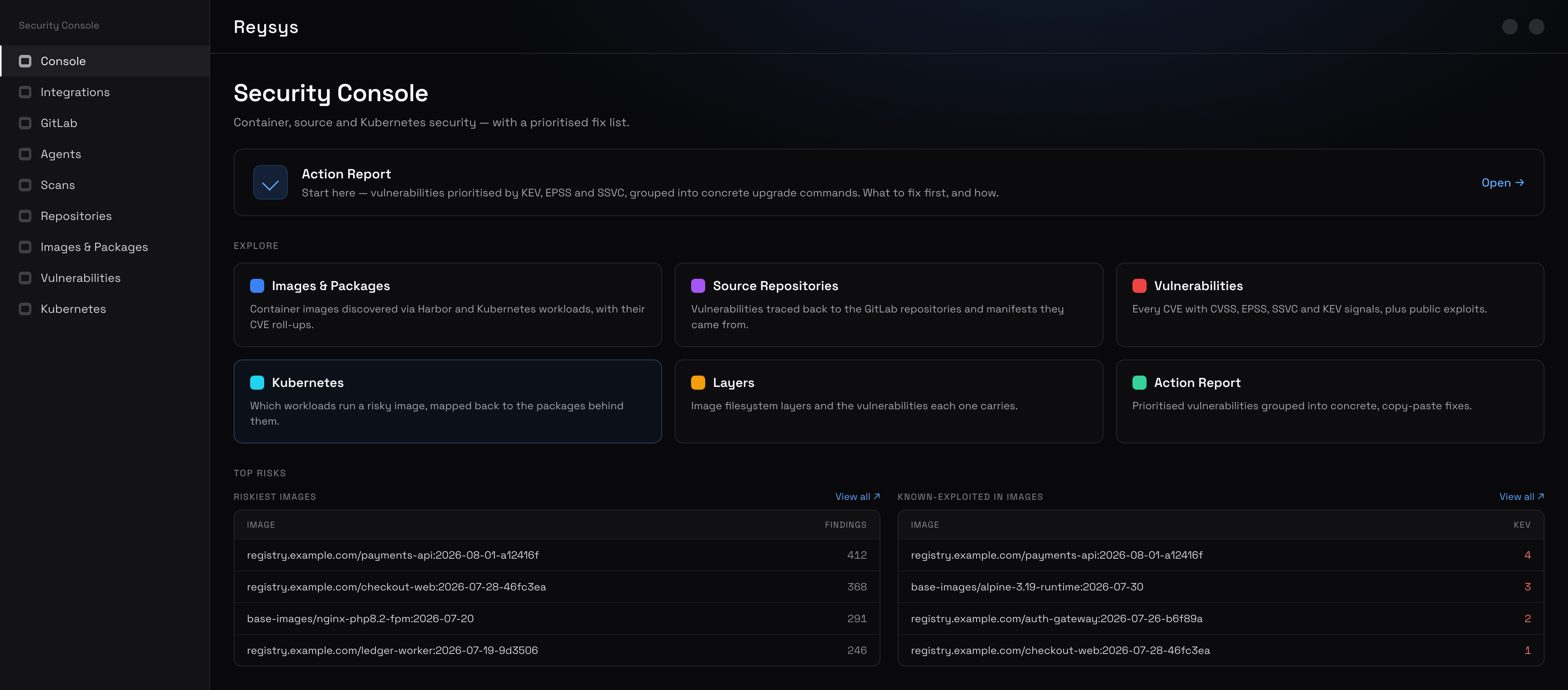
Three sources, one scan, one ranked backlog.
Harbor registries: every layer, package and dependency in the images you build and pull.
GitLab projects and their manifests, so fixes land where the code lives.
Running workloads mapped back to the images and packages behind them, via an agent deployed in-cluster.
Six signals, weighed together. Severity alone decides nothing.
The identifier for the vulnerability itself, traced back to the package and image that introduced it.
How severe the vulnerability could be if someone exploited it.
The probability that it will actually be exploited in the next thirty days.
Whether CISA has recorded it being exploited in the wild, not just in theory.
The decision framework that turns those signals into an action rather than a number.
The class of weakness behind the finding, so recurring patterns across your estate become visible.
The result is an order that matches reality: a CVSS 9.8 with no exploit activity ranks below a CVSS 6.5 that appears in KEV.
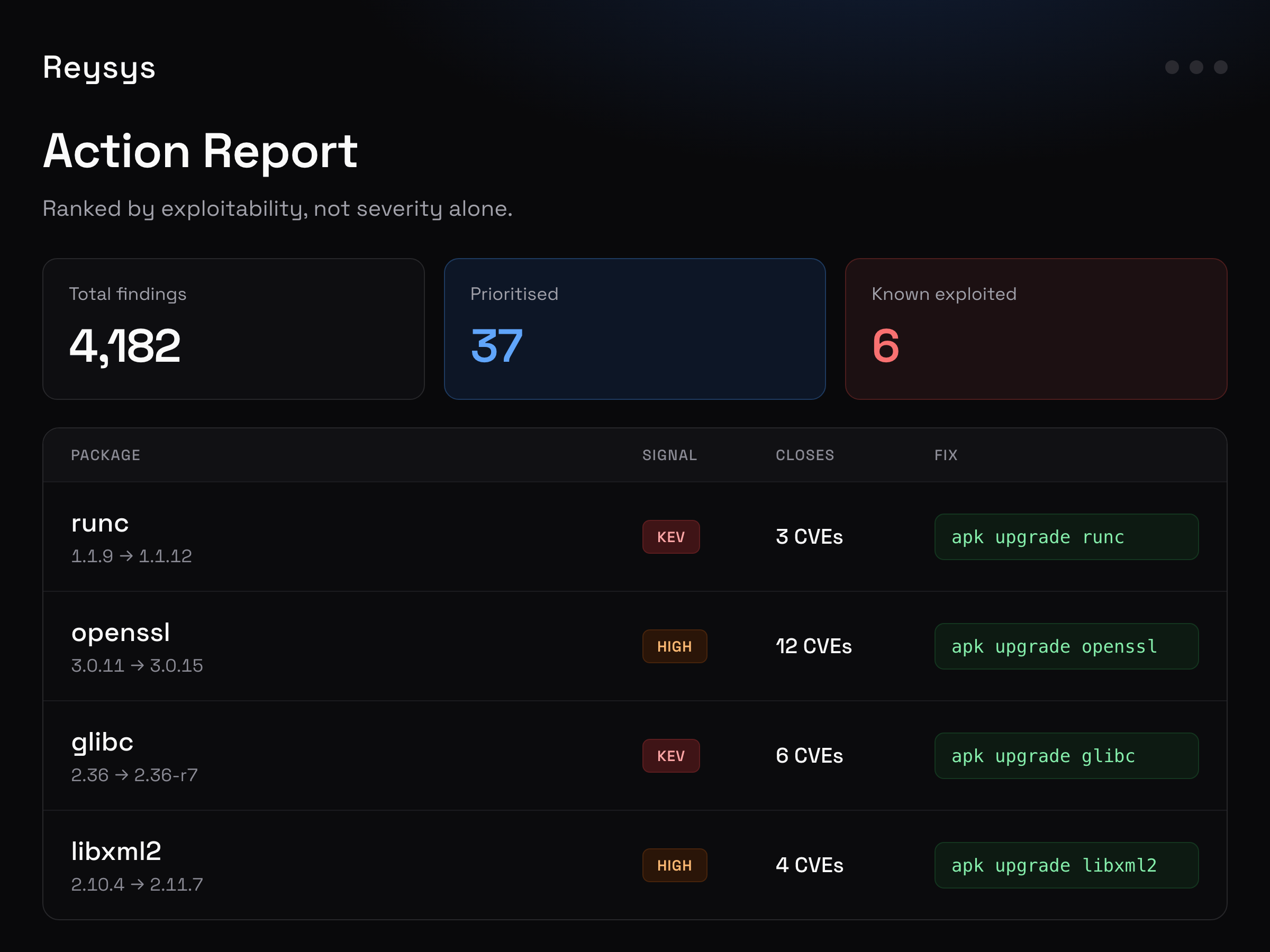
The report is the workflow. Four steps from a ranked list to a verified fix.
Every finding is ranked by exploitability rather than severity alone, so the top of the list is the work that actually matters.
Findings are grouped by package, so you see one item to fix instead of every CVE it contains.
Each group carries the upgrade command that closes it, and the list of CVEs that command resolves.
Rescan the repository, registry or cluster and the report reflects what actually changed.
Coming soon: a security graph connecting images, packages, workloads and identities, so you can trace a finding through everything it touches.
Connect a registry, a GitLab project or a cluster and Reysys returns a ranked list of what to fix — with the commands to fix it.
Request a demo